
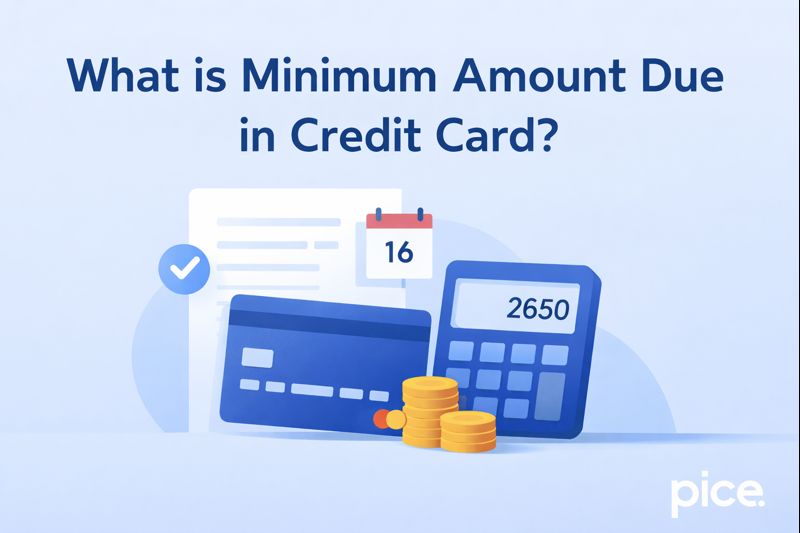
What is Minimum Amount Due in Credit Card?


Bio
Shreyansh Singh, an IIT Kanpur alumnus, has eight years of experience in the finance industry. He has spent 5 years at American Express developing mid to long-term strategies for multiple markets including US, Europe and India. Shreyansh currently leads Growth and Strategy initiatives at Pice.
- 28 Jan 26
- 8 mins

Share


What is Minimum Amount Due in Credit Card?
 Shreyansh Singh
- 08 Mins
- 28-01-26


Key Takeaways
- Minimum amount due in credit card is the lowest amount you must pay to keep your credit card account active and avoid default.
- Paying the minimum amount due prevents late fees but interest continues on the remaining balance.
- When cash is tight, MAD acts as a short-term relief option to protect your credit score.
- Continuously paying only the minimum amount due can lead to higher interest and prolonged repayment.
- Paying the total amount due saves interest, improves credit health, and offers financial peace of mind.
Imagine you have an urgent bill to pay this month, which is preventing you from paying the full outstanding balance on your credit card. In this scenario, there is one thing that can come to your rescue and that is Minimum Amount Due (MAD).
By just paying the minimum payment due, you can save yourself from being a defaulter and keep your credit card account active. This read will provide you with a detailed explanation of what is minimum amount due in credit card. So keep reading to know more and save the day!
What is Minimum Amount Due in Credit Card: Definition and Example
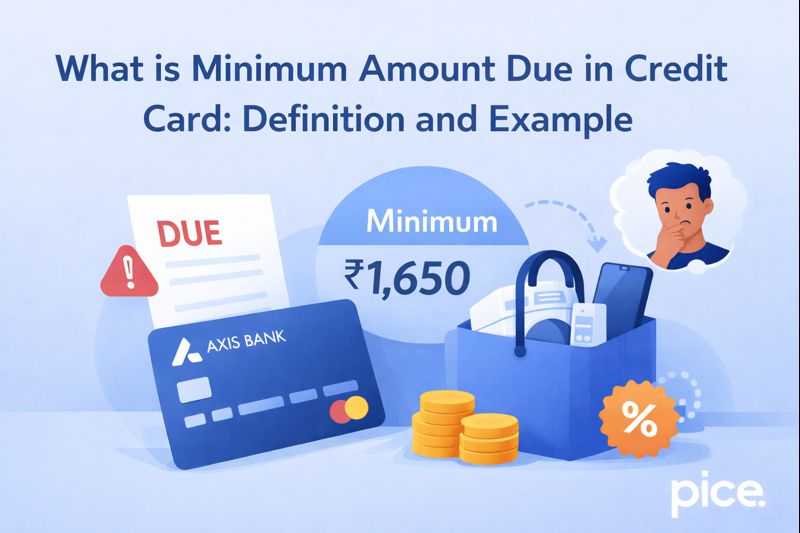
If you come across the term ‘Minimum Amount Due’ while dealing with a credit card, then it refers to the minimum amount you would have to pay on your outstanding balance to keep your credit card account in good standing.
So, the minimum amount due, or MAD, is the amount you will need to pay to avoid any kinds of additional financial charges and remain on the favourable side of your lender.
Example to Calculate the Minimum Amount Due (MAD)
Suppose Mr. Rajan bought an Axis Bank credit card and his credit card billing cycle is the 5th of every month. He made a purchase of a washing machine for ₹20,000 on the 15th of September and a smartphone for ₹10,000 on the 20th of September. He now has an outstanding balance of ₹30,000 for October.
The financial institutions’ (Axis Bank) terms and conditions include a minimum payment of 2% of the total balance, a monthly interest rate of 3% and a late payment fee of ₹150.
Now, let us calculate his Minimum Amount Due (MAD):
- Minimum Payment = 2% of ₹30,000 = (2/100) x 30000 = ₹600
- Interest = 3% of ₹30,000 = (3/100) x 30000 = ₹900
- Late Payment Charges= ₹150
So, his Total Minimum Amount Due = ₹600 + ₹900 + ₹150 = ₹1,650
If he chooses to pay only ₹1,650 this month, his account will remain active and penalty-free. However, the remaining unpaid balance of ₹28,350 will continue to attract interest in the next billing cycle, increasing his total repayment cost over time.
Note: This is an illustrative example, and the rates, as well as the late fee, depend on different banks.
5 Pros of Paying Minimum Amount Due (MAD)
- Avoid Late Payment Penalties
By paying the Minimum Amount Due, you can prevent yourself from late payment fees being charged to your credit card account. This makes this kind of payment helpful in maintaining your credit card’s active status and avoiding unnecessary financial burden.
- Avoid High Interests
When you pay the minimum due, you reduce the portion of your balance on which interest is calculated. Even though this is not the ideal long-term thing that you can do, it slows the rate at which interest compounds. Therefore, it helps you to manage short-term cash flow without facing overwhelming interest charges.
- Manage Credit Utilisation Ratio
Furthermore, if you make the minimum payment, it will also help you to maintain a healthy credit utilisation ratio by slightly lowering your outstanding balance. This also ensures your credit usage does not appear excessively high, which can, in a way, protect your CIBIL score.
- Prevent Payment Default
Additionally, if you pay the minimum amount due, your account remains in good standing with the bank. You will prevent it from being marked as a default, thereby ultimately keeping your repayment record clean and protecting you from negative entries on your credit report.
- Positive Account Status
Along with other benefits, when you regularly pay at least the minimum due, your card issuer considers your account active and responsible. It signals to them that you are at least making an effort to meet payment obligations.
Must reads
4 Cons of Paying Minimum Amount Due (MAD)
- Interest Accumulation
If you are paying only the minimum due, it will mean your remaining unpaid balance will continue to attract interest. With time, this can be a really hectic issue as your debt can accumulate and become significantly high. This will make your total due amount much higher than the original spending.
- Infinite Debt
Just paying the minimum every month, your outstanding balance will barely be reduced. Due to this, you will also end up getting into a debt trap with piling interest. This will ultimately extend your repayment for years and make it hard to achieve good financial health in future.
- Financial Stress
Moreover, ongoing interest charges that barely add anything positive to your account, plus slow repayment, can strain your finances. Always seeing your balance high despite consistent payments can also cause anxiety and limit your ability to save or meet other financial goals.
- Reduced Creditworthiness
If you are carrying forward large unpaid balances and only making minimum payments, it can hurt your credit profile. Lenders will see this as a behavioural pattern and a sign of poor financial management. This will reduce your chances of getting new personal loans or credit cards in the future.
Advantages of Paying the Full Amount Due
- Good Credit Score
When you pay your total amount due every month on time, it signals good financial management. Moreover, you demonstrate strong repayment discipline, which can be a positive in the eyes of lenders in the future. This also improves your credit score, showing lenders that you manage your debts responsibly and they can go with you for higher credit limits confidently.
- Savings on Interest Charges
When you pay the full amount, it ensures that you do not incur any interest or finance charges. This might seem small at first glance, but with time, it can save you a huge amount of money. With each month’s savings, you can keep your total spending transparent. This will let you enjoy the benefits of credit without unnecessary costs.
- Financial Control
Finally, when you clear your entire bill every month, it will help you stay in control of your finances. You will avoid debt accumulation, maintain a clear budget and enjoy peace of mind knowing you are using your credit card smartly without falling into repayment traps. This way, you will also keep your mind free for future financial investments.
How to Plan Payment of a Credit Card: Tips and Timing
When to Only Pay MAD
- Emergency Expenses: If you have other more important payments to make, then paying only the minimum helps you to prevent damage to your credit score.
- Prioritise High-Interest Loans: You can also pay the minimum on low-interest cards if you want to focus on clearing high-interest debts first.
- Zero-Interest Offers: During the interest-free period/promotional period, interest does not apply on the outstanding balance, so you can just pay the MAD, but remember to clear the balance before the period ends.
4 Smart Repayment Tips
- Create a Budget: You should plan your monthly expenses and create a budget to aim for paying more than MAD.
- Automate Payments: You can also set up auto-pay for MAD, then additionally make extra payments manually whenever possible.
- Try Balance Transfers: Try moving high-interest balances to a 0% or lower-interest card; it can save you a lot on accumulating interest.
- Seek Guidance: Never shy away from guidance; contact your issuer or a credit counsellor if you are struggling to manage multiple payments.
4 Tips to Avoid Late Payment Fees
- Always try to pay the total outstanding or at least a set percentage above the MAD every month.
- Review your monthly credit card statements regularly for payment due dates, interest rates and outstanding balances.
- Automate EMI and bill payments, which can help you with reminders.
- Monitor your spending patterns monthly and set a budget for timely repayments.
💡For your bill payments and tracking business transactions, use the PICE App.
Must reads
Conclusion
Knowing what the minimum amount due in credit card is essential for emergency occasions. By just paying the MAD in a month, you can prevent your account from defaulting and maintain a positive account status. You just need to remember not to make it a habit to pay the MAD every month, as it can be harmful to your account.
FAQs
What is minimum amount due in credit card?
It is the minimum payment required by the bank to keep your credit card account in good standing.
How is the minimum amount due calculated?
It usually includes a percentage of the outstanding balance plus interest, EMIs, and applicable fees.
Does paying MAD affect my credit score?
Paying MAD avoids negative marks, but consistently high balances may still impact your score.
What happens if I don’t pay the minimum amount due?
Your account may be marked overdue, attracting late fees and damaging your credit score.
Is minimum amount due the same for all banks?
No, the MAD calculation varies based on bank policies and card terms.
Read More About Credit Card





About the author

Key Takeaways The simplest rule for how to pay credit...
 0
0
0
Related Articles





×


Want an answer to all your B2B Payment Problems?
Pay your Vendors and Collect from customers with ease using Pice's Payment Solutions. Get:
-
 Instant Transfer
-
 Lowest Rates
-
 Credit on all transaction